

In short
- A high-end interior depends on the coherence of the whole, not on accumulating beautiful brands.
- Kitchens, storage and furniture: Poliform, Boffi and Minotti for their continuity between architecture and furniture.
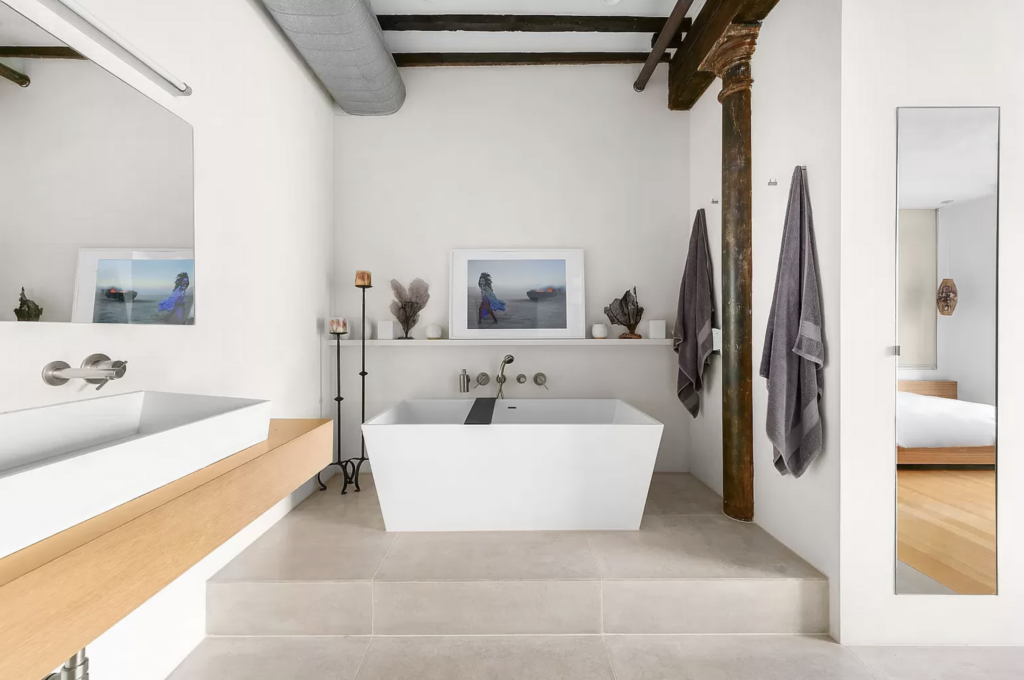
- Bathrooms: Antoniolupi for fittings with an architectural design.
- Lighting: Targetti for architectural lighting, Davide Groppi for more poetic light fittings.
- Materials: Oberflex for wood, Marius Aurenti for polished concrete and plasters, Marazzi for ceramics.
- Technical details: Meljac for switches, Cinier for designer radiators.
- Most of these brands can be seen in showrooms in Lyon, near Annecy or in Geneva; the others are available through specifiers and samples.
My reference brands and addresses for a high-end interior architecture project
Designing an interior is not simply a matter of choosing beautiful furniture, beautiful materials or high-end equipment. A successful project depends above all on the coherence of the whole: the architecture of the volumes, circulation, light, materials, colours, bespoke joinery and technical details must all serve the same intention.
In my work as an interior architect in Lyon, and also on projects around Annecy, in the Pays de Gex and in neighbouring Switzerland, I am regularly looking for materials, equipment and manufacturers able to meet the demands of exacting projects.
Over the years and over many projects, certain companies have become true references for me. I appreciate them for different reasons: the quality of their design, their technical mastery, the richness of their materials or their ability to offer solutions sober enough to fit into an overall interior architecture.
Here are some of the brands and addresses I particularly like and enjoy introducing to my clients.
Kitchens, storage and furniture: brands that extend the architecture
Poliform: a global vision of the contemporary interior
It is hard to talk about contemporary interior design without mentioning Poliform.
The Italian company offers a particularly comprehensive approach to the home: kitchens, dressing rooms, bookcases, storage, living-room and bedroom furniture can all be designed in the same architectural language.
It is precisely this coherence that I find interesting.
In a high-end renovation project, I generally try to avoid the impression of an accumulation of separate objects or solutions. The kitchen does not have to be perceived as an element added to the living room, any more than the dressing room should look like a simple row of wardrobes.
Poliform systems make it possible to work with great continuity between architecture and furniture. The compositions play on proportions, vertical rhythms, the alternation of solid volumes and display cabinets, and a particularly well-controlled palette of woods, lacquers, stones and metallic finishes.
I particularly appreciate the brand’s ability to create sophisticated interiors without being showy. The lines are generally sober, the details precise and the materials rich enough to create warm atmospheres.
In Lyon, the Poliform showroom lets you discover kitchen, storage and furniture systems in full-scale compositions. For a client, this visit is often far more telling than a catalogue or an isolated sample: it helps you understand the quality of a finish, the feel of a wood, the slimness of a profile or how a mechanism actually works.
Poliform Lyon
1 rue du Colonel Chambonnet
69002 Lyon
Boffi: when the kitchen and bathroom become architecture
In a high-end renovation, the kitchen and bathroom can no longer be thought of as simple technical rooms to which equipment is added.
They are an integral part of the project’s interior architecture.
This is precisely the vision Boffi has developed over many years. The Italian company holds a special place in contemporary design thanks to an extremely architectural approach to kitchens, bathrooms and storage systems.
I particularly appreciate the rigour of its design.
Boffi kitchens work with volumes very precisely: large continuous surfaces, horizontal lines, monolithic elements, integrated tall units and natural materials combine in compositions that go far beyond a simple juxtaposition of units.
In an open-plan space, this approach makes it possible to design the kitchen as a true component of the living room’s architecture.
The island can become a structuring volume. Tall units can merge into a wall. Technical equipment can disappear behind fronts or retractable systems. The kitchen remains fully functional while contributing to the overall composition of the space.
The same standards are found in the bathroom collections, where furniture, washbasins and fittings are designed in a deliberately sober, architectural language.
For me, Boffi represents a certain idea of contemporary luxury: a luxury based less on accumulation or decorative effect than on the quality of proportions, materials and details.
It is a particularly interesting approach for projects in which I am looking for a pared-back but never cold interior architecture, where natural materials and craftsmanship bring depth and warmth.
Minotti: contemporary elegance and mastery of proportions
Furniture plays an essential role in how an interior architecture is perceived.
A space can be perfectly designed in its volumes, circulation and materials, yet lose much of its coherence if the furniture is not selected with the same care.
Minotti is one of the companies I appreciate for the quality of its architectural language and its mastery of proportions.
The Italian brand develops collections of sofas, armchairs, tables, seating and occasional furniture that make it possible to compose particularly coherent contemporary spaces. Its world is based on controlled lines, generous volumes and a deliberately sophisticated palette of materials.
I particularly appreciate the way Minotti collections work with the relationships between the different heights and scales of furniture.
In a large living room, for example, the success of a composition does not depend solely on the choice of a sofa. A balance must be created between the seating, coffee tables, armchairs, light fittings and circulation areas.
Minotti’s modular systems make it possible to structure large volumes while retaining a certain visual lightness. The compositions can organise several uses within the same room: entertaining, conversation, reading or simply enjoying a view.
Materials also play an important part in the company’s identity. Wood, stone, metal, leather and textiles are combined with great precision, in generally sober and deep palettes.
This approach matches the way I design interiors: favouring legible architecture, a controlled palette and quality materials rather than an accumulation of effects.
In a high-end project, Minotti furniture can thus naturally extend the architectural work and help create elegant, comfortable and lasting spaces.
Bathrooms: fittings designed as architecture
Antoniolupi: designing the bathroom as a true piece of architecture
The bathroom has become one of the most interesting spaces to design in a contemporary house or apartment.
Long treated mainly as a functional room, it can now become a space in its own right, designed with the same level of care as the living room or the kitchen.
It is with this approach that Antoniolupi’s collections come into their own.
The Italian brand offers washbasins, baths, furniture, mirrors, taps and accessories whose design is often very architectural. Some pieces have an almost sculptural presence, while others, on the contrary, know how to disappear and let the material or the volume speak.
In my projects, I pay particular attention to the way a sanitary fitting relates to its surroundings. A washbasin is never just a washbasin: its position determines that of the mirror, the lighting, the electrical sockets, the storage and sometimes even the overall layout of the room.
Antoniolupi collections are particularly suited to projects in which the bathroom is designed as a coherent whole, with attention paid to alignments, proportions, details and materials.
I also like the brand’s work on colour. High-end sanitary ware is no longer limited to traditional white: mineral shades, matt finishes and deep tones now make it possible to create much more personal bathrooms.
Lighting: architectural lighting and designer light fittings
Targetti: architectural lighting before decorative fittings
Lighting is probably one of the most underestimated subjects in renovation projects.
A very beautiful interior can lose much of its quality with poorly designed lighting. Conversely, precise lighting design can completely transform the perception of volumes and materials.
I particularly appreciate Targetti’s solutions for their architectural approach to light.
It is not just a matter of choosing a beautiful light fitting, but of determining precisely what you want to light, with what intensity, what colour temperature and what beam angle.
Should a work of art be lit directly? Should light graze a textured wall? Should a bookcase be highlighted? Should soft lighting be created for night-time circulation? Should a wooden ceiling be showcased? Should a worktop be lit precisely without causing glare?
Each situation requires a specific answer.
In a high-end residential project, I like to work with several lighting scenes. The atmosphere of a living room is obviously not the same for entertaining friends, dining, reading or watching a film. The lighting must support these different uses.
Targetti’s technical ranges make it possible to work with discreet fittings, precise optics and different systems for integration into the architecture.
For me, good architectural lighting should often be felt before it is seen.
Davide Groppi: light as an architectural and poetic gesture
Some light fittings seek to catch the eye immediately. Others prefer almost to disappear, letting only the light they produce be perceived.
It is this second approach that characterises much of Davide Groppi’s work.
For several decades, the Italian company has developed a particularly sensitive vision of light, at the crossroads of design, architecture and poetry. Its creations often stand out for their great economy of means: a line, a wire, a point of light or an almost invisible source is enough to transform the perception of a space.
I particularly appreciate this search for lightness.
In an interior architecture project, light does not necessarily have to come from imposing or spectacular objects. It can discreetly accompany a table, highlight a work of art, create a presence in a corner or bring soft light to a reading area.
Davide Groppi light fittings make it possible to work precisely on this relationship between presence and disappearance. Some creations become true graphic elements in the space, while others seem almost to vanish into the architecture.
This approach complements more technical architectural lighting particularly well. Where spotlights, light lines and integrated lighting build the different atmospheres of a project, a Davide Groppi light fitting can bring a more sensitive gesture and give a space a particular identity.
I like the idea that a light fitting can be extremely simple in its design while producing a strong emotion. In the contemporary interiors I design, this restraint preserves the legibility of volumes and materials without giving up a real presence.
Materials: wood, mineral finishes and ceramics
Oberflex: the richness of wood in interior architecture
Wood plays an important part in my work.
I particularly like contemporary, pared-back interiors, but I almost always try to bring warmth to them through materials. Wood is precisely what balances the rigour of an architectural design.
In this respect, Oberflex is a particularly interesting reference.
The French company offers a very wide range of decorative surfaces in real wood, with many species, finishes and textures. These panels can be used for joinery, doors, bookcases, wall cladding and ceilings.
The advantage of a material like this is that it can create real architectural continuity.
The same wood can, for example, extend from a piece of furniture to a wall panel, clad a concealed door or create a sequence in a circulation area.
In the projects I design, I particularly like working with contrasts between very sober volumes and a few more expressive materials: a deep walnut, a textured wood, a natural stone or a mineral plaster.
The quality of an interior often depends on this balance. Too many different materials can blur the reading of the project; too few can make the whole cold or impersonal.
The challenge is therefore to select a limited palette and use it precisely.
Marius Aurenti: polished concrete and mineral finishes
Mineral finishes are particularly interesting in renovation.
They make it possible to create continuous surfaces and work with colour much more subtly than a simple uniform paint.
Marius Aurenti is a French company I appreciate for its polished concrete, lime plasters, paints and decorative finishes.
Polished concrete is often associated with an industrial aesthetic. Yet this is a very narrow view of the material.
Used in a soft shade and combined with wood, natural stone or textiles, it can create an extremely warm atmosphere. It works in a living room, a kitchen, a bathroom or on certain pieces of furniture.
As always, the result depends enormously on the specification, the preparation of the substrate and the quality of application.
I generally advise against accumulating too many decorative effects. A strong material often works best on a clearly defined surface, in dialogue with more sober elements.
In a contemporary renovation, Marius Aurenti finishes can create an interesting continuity between several spaces while retaining a depth and vibration that you do not find on a perfectly uniform industrial surface.
Marazzi: ceramics and porcelain stoneware serving architecture
Choosing tiles is often more complex than it seems.
It is not only a question of colour or texture. You also need to work on the format, the tile layout, the width of the joints, the junctions with other coverings, the cuts and the changes of plane.
A beautiful ceramic with a poorly planned layout can produce a very disappointing result.
Conversely, a relatively sober product can become particularly elegant when it is properly integrated into the project.
Marazzi offers a depth of range that meets many needs: large formats, surfaces inspired by stone, marble or concrete, smaller, more decorative pieces and solutions suited to both floors and walls.
I use these products with particular attention to their architectural integration.
In a bathroom, for example, the tile layout must be coordinated with the position of the niches, the taps, the vanity unit and the shower screen. These details are rarely spectacular on a plan, but they make all the difference once the project is complete.
The Marazzi showroom in Lyon is a particularly useful address for discovering the collections in large formats and comparing materials in good conditions.
Marazzi Showroom Lyon
117 avenue Jean Jaurès
69007 Lyon
Technical details: switches and designer radiators
Meljac: when technical details become design features
In an interior architecture project, switches and electrical sockets are often considered very late.
That is a mistake.
They are present in every room and can have a significant impact on the perceived quality of an interior.
I appreciate Meljac collections for the quality of their materials and their ability to fit into projects with very different styles.
Solid brass, glass or porcelain make it possible to create switchgear that can be extremely discreet or, on the contrary, become a true decorative detail.
In a contemporary interior, a patinated brass plate can create an interesting contrast with natural stone or a walnut panel. In a period apartment, porcelain switchgear can echo the mouldings and heritage features without looking like an artificial reconstruction.
It is precisely these details that contribute to the overall quality of a project.
High-end is not just about installing expensive equipment. Above all, it depends on coherence across every scale of the project, from the overall organisation of the spaces down to the design of a handle or a switch.
Cinier: turning the radiator into an architectural object
Heating is another subject often treated only from a technical angle.
Yet in a renovation, the position and appearance of radiators can have a considerable impact on how a room is perceived.
Cinier offers a particularly interesting approach to the contemporary radiator and towel rail. The units can become true architectural elements and fit into the overall composition of a room.
This approach is particularly relevant when the radiator is installed in a very visible spot and it is impossible or undesirable to conceal it.
Rather than putting up with a piece of technical equipment, it then becomes possible to embrace it as part of the project.
In a bathroom, for example, the choice of towel rail must be coordinated with the materials, the lines of the furniture and the taps. In a living room, the shape and proportions of a radiator can contribute to the rhythm of a wall in the same way as a work of art or a piece of joinery.
How I select brands and materials for a project
I do not have a fixed catalogue of brands that I systematically impose on all my clients.
Each project has its own architecture, budget, context and personality.
The role of the interior architect is precisely to build a specific response.
Materials and equipment are therefore selected gradually during the design process. The choice depends in particular on the existing architecture, the uses, the natural light, the level of finish sought and the technical constraints of the site.
Some brands are chosen for their ability to offer highly integrated solutions. Others are selected for a material, a finish or a specific product.
What matters most is coherence.
A Poliform kitchen, an Oberflex wood panel, a Marius Aurenti finish, a Marazzi ceramic, an Antoniolupi fitting, Targetti lighting or Meljac switchgear only truly make sense when they contribute to an interior architecture designed as a whole.
The importance of showrooms and samples in the design process
Digital images have become essential in designing a project, but they do not replace the physical experience of a material.
A photograph does not really convey the depth of a wood, the texture of a mineral plaster, the reflection of a metal or the nuances of a stone.
That is why I attach great importance to showrooms, material libraries and samples.
During the design phases, I prefer to compare materials side by side whenever possible. A wood may look very beautiful on its own and turn out to be too red or too dark next to the chosen stone. A wall colour may work in abundant natural light but look dull in a poorly lit corridor.
Design work also means anticipating these interactions.
In Lyon and the surrounding region, the large number of showrooms and specialist distributors is a real advantage for renovation projects. It allows clients to see the products, understand differences in quality and make better-informed decisions.
Where to discover these brands in Lyon, Annecy and Geneva
Materials, finishes and manufacturing quality are sometimes hard to appreciate in a photograph. Whenever possible, I therefore recommend discovering the products in a showroom, looking at the materials at full scale and comparing finishes before finalising the choices for a project.
Poliform
Poliform Lyon
1 rue du Colonel Chambonnet
69002 Lyon
Official website: poliform.it
Antoniolupi
Espace 55 – Antoniolupi showroom
5 rue Espace 55, Parc de Calvi
74330 Poisy, near Annecy
Espace 55 has an exhibition space specifically dedicated to the Antoniolupi collections.
Official website: antoniolupi.it
Targetti
Targetti works mainly with architects, interior architects, lighting designers and lighting professionals. The brand does not have a single-brand showroom in Lyon, Annecy or Geneva.
For a project, I recommend contacting the official sales network or arranging a product presentation with a brand representative.
Official website: targetti.com
Oberflex
Oberflex does not have a permanent showroom in Lyon, Annecy or Geneva. The collections are mainly intended for architects, interior architects and joiners, and can be specified using samples and the manufacturer’s material library.
The Ober material library is located in Paris:
La Matériauthèque Ober
7 rue du Bois-de-Boulogne
75016 Paris
Official website: ober-surfaces.com
Marius Aurenti
Matières Marius Aurenti – Lyon
86 avenue Maréchal de Saxe
69003 Lyon
This space showcases the polished concrete, plasters, paints and other finishes developed by the company.
Official website: mariusaurenti.com
Marazzi
Marazzi Showroom Lyon
117 avenue Jean Jaurès
69007 Lyon
The showroom lets you discover the ceramic and porcelain stoneware collections in formats and settings that are hard to appreciate from a sample alone.
Official website: marazzi.fr
Meljac
Meljac Lyon
5 rue Charles Dullin
69002 Lyon
This address lets you discover the collections of switches and electrical fittings, as well as the different materials and finishes offered by the company.
Official website: meljac.com
Cinier
Cinier does not currently have a permanent showroom in Lyon, Annecy or Geneva. The company has a showroom in Paris and works with a network of specifiers and partners.
Showroom Cinier
10 rue du Pré-aux-Clercs
75007 Paris
Official website: cinier.com
Davide Groppi
Davide Groppi light fittings are distributed through an international network of specialist retailers. The brand does not currently have a single-brand showroom in Lyon, Annecy or Geneva.
I recommend checking the manufacturer’s “Where to buy” section directly to identify the distributor that actually displays the models you are looking for, as the collections on show can vary from one retailer to another.
Official website: davidegroppi.com
Boffi
Boffi – Arcadia Meubles
20 rue des Eaux-Vives
1207 Geneva, Switzerland
This address lets you discover the Boffi world in Geneva and is particularly interesting for projects in French-speaking Switzerland and the Lake Geneva area.
Official website: boffi.com
Minotti
Minotti Lyon by Maison Home Design
48 rue Auguste Comte
69002 Lyon
The Lyon showroom presents Minotti furniture collections in a setting that lets you appreciate the compositions, materials and proportions at full scale.
Official website: minotti.com
Designing a lasting interior rather than following a trend
Trends are useful for understanding how the home is evolving, but I am wary of interiors built solely around fashions.
A complete renovation is a significant investment and must be able to stand the test of time.
I therefore generally favour a fairly timeless architecture, with quality materials and a coherent palette. The most expressive elements can then be brought in by furniture, works of art, textiles or certain details that are easier to change.
The companies presented in this article have very different identities, but in my view they share the same standards: they offer products capable of contributing to a true interior architecture project.
It is these standards that I look for in my work: designing coherent, functional and sensitive spaces in which architecture, light, materials and details form a whole.
Each project then becomes a unique composition, built around a place and the people who will live there.
FAQ: key takeaways
Where can you see high-end design brands in Lyon?
Several companies have a showroom in Lyon: Poliform and Minotti in the 2nd arrondissement, as does Meljac, Marius Aurenti in the 3rd and Marazzi in the 7th.
Why visit a showroom before choosing your materials?
Because a photo conveys neither the depth of a wood, nor the texture of a plaster, nor the nuances of a stone. Comparing materials side by side avoids unpleasant surprises once they are installed.
Does an interior architect impose their own brands?
No. The selection is built project by project, according to the existing architecture, the uses, the light and the budget.
Are some brands only available to professionals?
Yes. Targetti, Oberflex and Cinier work mainly with architects and specifiers, using samples or dedicated presentations.
What makes a high-end interior?
Coherence across every scale of the project, from the volumes down to the light switch, more than the price of the equipment.
Are you planning a project and would like support in choosing materials? Contact the studio.