

Renovation of a duplex in Lyon: unlocking the full potential of an exceptional apartment.
Not all duplexes apartments suffer from a lack of space.
Very often, they suffer from poor spatial organization.
Beyond differences in context, these projects illustrate a conviction that guides all my work: the success of a renovation depends not only on the quality of materials or finishes but on the coherence of the architectural choices as a whole.
A duplex is not an apartment like any other.
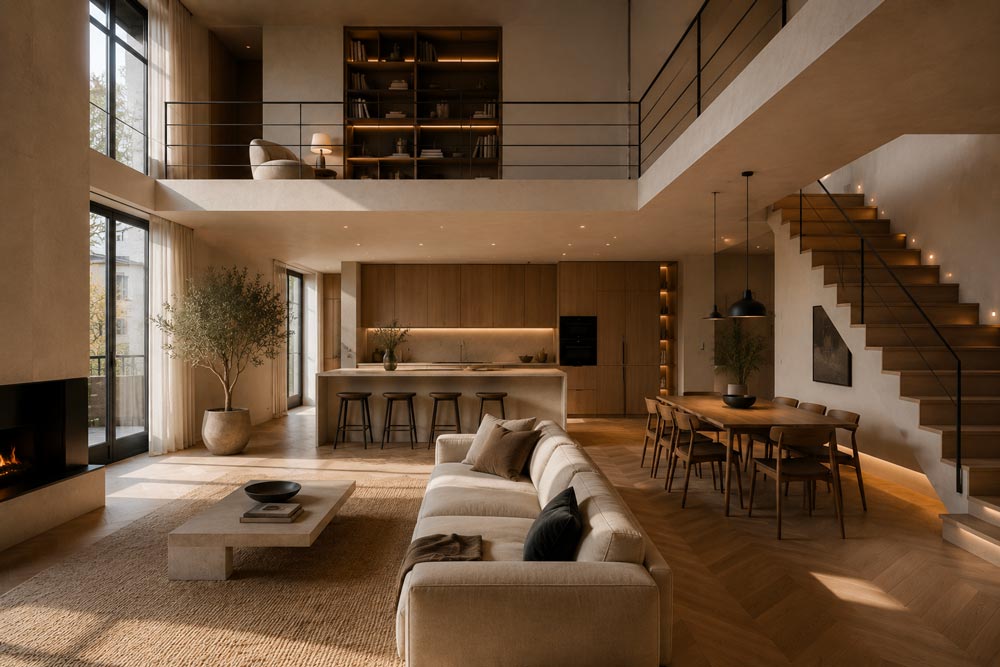
Its split-level layout, spatial volumes, sightlines, and vertical connectivity offer exceptional architectural potential. However, this unique character also entails constraints rarely encountered in a traditional apartment.
As an interior architect in Lyon, I have had the opportunity to oversee several complete duplex renovations. Each project had its own unique identity, yet all shared the same goal: transforming a space—sometimes spectacular in its own right—into a home that is truly pleasant to live in, functional, and sustainable.
A successful renovation is not simply a matter of modernizing a duplex.
It involves revealing its full architectural potential.
Why are duplexes so appealing in Lyon?
The duplex represents a particularly sought-after type of housing.
In neighborhoods such as Les Brotteaux, La Croix-Rousse, the 6th arrondissement, and Vieux Lyon—as well as in certain parts of Villeurbanne—these properties often attract buyers looking for an apartment that offers the qualities of a house while retaining the advantages of city living.
They appeal particularly thanks to:
This clientele generally seeks far more than an aesthetic renovation.
She wants a project that is coherent, sustainable, and perfectly suited to her lifestyle.
Why does renovating a duplex require a different approach?
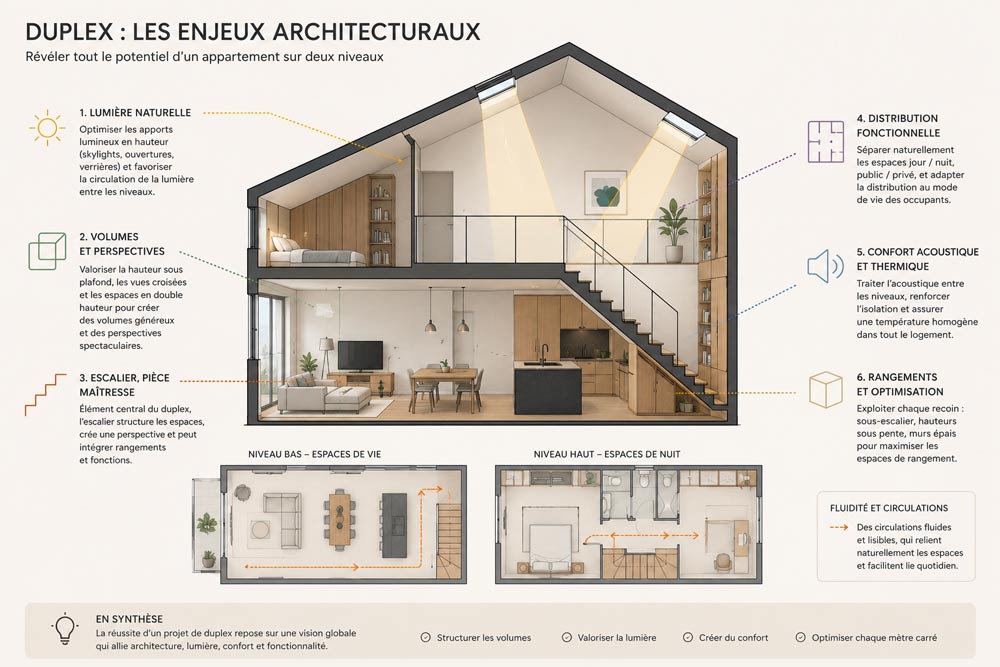
In a standard apartment, the issues remain essentially horizontal.
In a duplex, everything becomes three-dimensional.
Each decision influences several spaces simultaneously.
The staircase.
Circulation areas.
The perspectives.
The views.
Light intake.
Ceiling heights.
The perception of volumes.
An apparently simple modification can completely transform the way the entire home is perceived.
It is precisely this spatial dimension that makes these projects particularly exciting.
The staircase: much more than a means of getting around
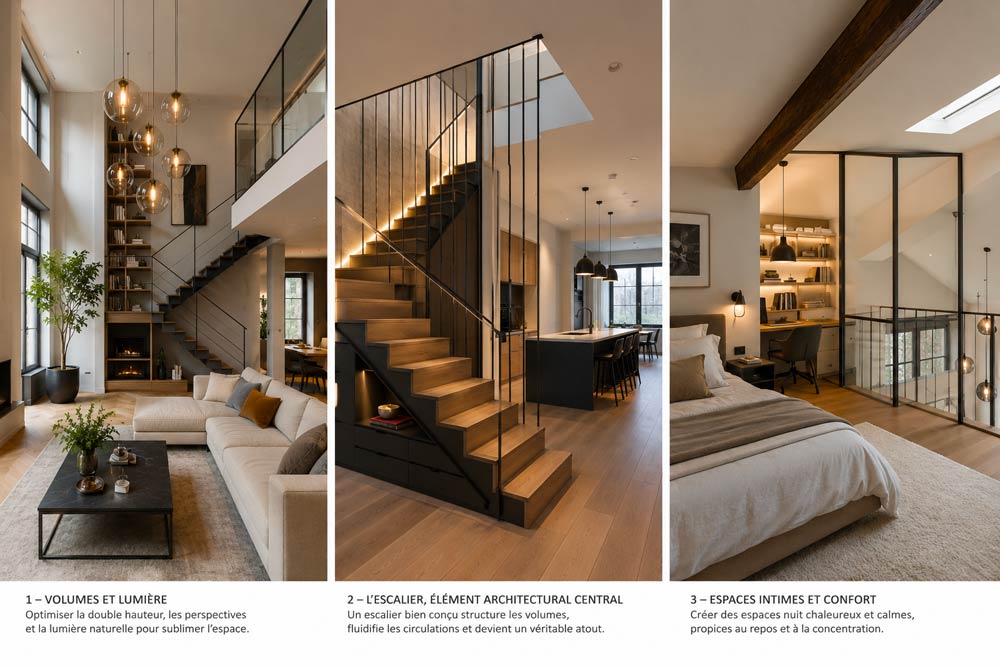
In many duplexes, the staircase occupies a central position.
However, it is often regarded solely as a functional element.
In reality, it constitutes one of the dwelling’s key architectural elements.
Depending on the project, it can:
Conversely, a poorly positioned staircase can fragment the spatial layout, reduce usable floor area, and darken certain rooms.
Its repositioning or transformation sometimes represents one of the most significant interventions in a complete renovation.
Make full use of the available space
The main asset of a duplex often lies in its spaciousness.
Double height.
Mezzanine.
Double-height living area.
Exposed roof structure.
Under the slope.
These features offer design possibilities that a traditional apartment does not allow.
The goal is not necessarily to build more.
It is primarily a matter of better revealing the existing space.
A play on perspectives.
A floor-to-ceiling bookcase.
Architectural lighting.
Custom-made joinery.
An interior glass partition.
Chaque intervention participe à renforcer l’identité du lieu.
Light: a major issue
In a duplex, light circulates differently.
Openings located at a certain level sometimes influence several spaces.
When the project allows, certain interventions can significantly improve this quality:
Light then becomes a genuine architectural material.
Completely rethinking living spaces
Renovating a duplex often provides an opportunity to rethink the original layout.
Kitchen area
Living room.
Master bedroom.
Office.
Bedrooms.
Laundry room.
Storage spaces.
Property owners’ expectations have evolved significantly in recent years.
Working from home.
Convivial kitchen.
Open spaces.
Master suites.
Dressing rooms.
Each project therefore deserves a comprehensive approach rather than a simple update.
There are numerous technical constraints.
Behind the quality of the spaces lie numerous technical aspects.
Structure.
Sound insulation.
Thermal comfort.
Ventilation.
Air conditioning.
Networks.
Fire safety.
In a duplex, these elements must be integrated during the initial design phases to avoid costly compromises during construction.
Acoustics: a comfort factor often underestimated
Duplexes generally benefit from a natural separation between living areas and bedrooms.
This organization already constitutes an advantage.
During a complete renovation, it is also possible to significantly improve acoustic comfort by treating floors, partitions, ceilings, and technical equipment.
Silence plays a key role in the perception of a high-end home.
It is part of what I call invisible luxury.
A project requiring genuine project management expertise.
Renovating a duplex often involves several trades:
Coordination becomes essential.
As an interior architect, my role is to design the project, anticipate interactions between the various parties involved, and guide the contractors through to the final handover, ensuring the overall coherence of the project.
Why do duplex owners seek comprehensive support?
Buyers of duplexes often make a significant investment.
They generally look for:
It is precisely in this type of project that the guidance of an interior architect proves truly valuable.
A successful renovation is not just about making an apartment look better.
It involves revealing everything that makes a duplex unique, while sustainably improving the property’s comfort, functionality, and value.
Not all duplexes apartments suffer from a lack of space.
Very often, they suffer from poor spatial organization.
The FL project in Villeurbanne perfectly illustrates this issue. This 95 m² inverted duplex offered great architectural potential, but the flow of movement, the staircase’s location, and the spatial layout limited the quality of daily life. The project notably involved relocating the staircase—a structural intervention that made it possible to completely rethink the home’s layout.
Key issues
Before the renovation, several factors hindered the duplex’s potential:
The goal, therefore, was not to create more floor area, but to make better use of the existing volumes.
Les réponses architecturales
The renovation centered on several major interventions:
These choices reflect a strong conviction: in a duplex, every intervention must simultaneously address functional, technical, and architectural considerations.
What this project illustrates
This project demonstrates that a successful renovation is not just about modernizing the finishes.
It involves revealing the spatial qualities of the duplex by working on circulation, the perception of volumes, and natural light.
In contrast to an urban duplex, the CR project in Grilly is situated in a prime location, offering unobstructed views of Lake Geneva and Mont Blanc. This exceptional setting profoundly influenced the design choices.
Spanning 160 m², this duplex underwent a comprehensive design and project management process, with a renovation budget of €140,000.
The starting point
The potential of the property was obvious.
However, the quality of the outdoor landscape was not sufficiently highlighted by the interior layout.
The challenge, therefore, was to create an interior architecture capable of complementing this relationship with the landscape rather than competing with it.
Design principles
In this type of project, several priorities naturally guide the design:
The goal was not solely to renovate a duplex.
The aim was to create a genuine living experience, in which interior spaces naturally extend the views of the expansive landscape.
What this project illustrates
This project demonstrates that renovating a high-end duplex goes far beyond the question of materials.
It relies on a balance between:
What these two projects have in common
Although very different, these two duplexes illustrate the same approach to renovation.
In Villeurbanne, the main challenge was to reinvent urban housing by optimizing every square meter and restructuring the circulation layout.
In Grilly, the project aimed to reveal the potential of a contemporary duplex set in an exceptional location.
In both cases, the approach remains the same:
Beyond differences in context, these projects illustrate a conviction that guides all my work: the success of a renovation depends not only on the quality of materials or finishes but on the coherence of the architectural choices as a whole.